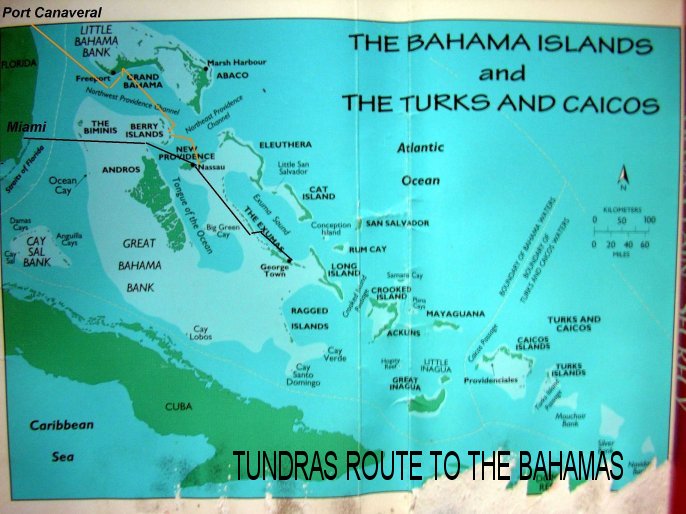
ARRIVING AT THE BAHAMAS FOR THE FIRST
TIME IN THE WINTER OF 1998
The following page outlines our two
separate visits to the Bahamas during the years 1998 to
1999. In 1999 we departed for the Bahamas en route to the
Caribbean. This was to be our last visit to the Bahamas aboard
Tundra.
To skip DIRECTLY to this time of departure
from Florida to the Bahamas and onto the Caribbeam you
can go to the page titled EASTERN CARIBBEAN or click
here on EASTERN CARIBBEAN
Directly below as you
scroll down on this page our first visit to the Bahamas is described. In order to go directly to our second
visit to the Bahamas click here on RETURN TO THE
BAHAMAS 1999
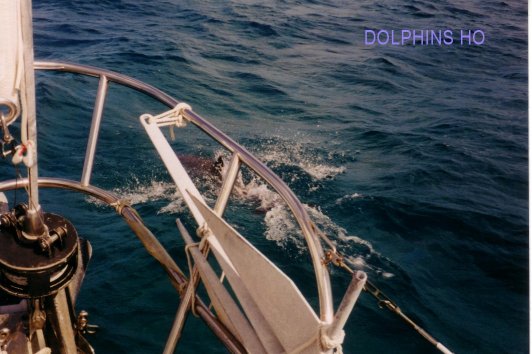
Finally on Jan 23 1998, we hauled anchor at 1530 to make passage for South Riding Rock in the Bahamas. Arrival at the Rock at 1000 the next morning found us sailing in brilliant sunshine. Dolphins did their welcome dance on the Bahama Banks. 1800 found us anchored at Russel Light on the banks. Rain showers passed through. With a NE blow settling in we hauled anchor with difficulty in the dark at 0400 and moved on. We slipped off the banks in the early morning of the 25th for a true rollicking sail down The Tongue of the Ocean. Tundra was completely salted en route, but she safely carried us along to our Nassau Harbour anchorage. We were grateful to follow a large ship in at 2100.
Bright and early next morn we tied up at the Nassau Harbour Club. In pouring rain it was heavenly to shower and relax on terre firma. A must see is the Aquarium at Atlantic Casino. Reprovisioned and rested we dropped mooring lines at the end of January and threaded our way through the coral heads east to Allen’s Cay. Wonderfully clear snorkelling and prehistoric looking iguanas ashore were pure delight. We switched our delta plough anchor for the danforth and hung on. As the northers blew through we sought out refuge at Highbourne Cay. It poured rain as we sloshed back and forth happily filling our tanks with fresh drinking water. Rinsing off the salt is always a treat!
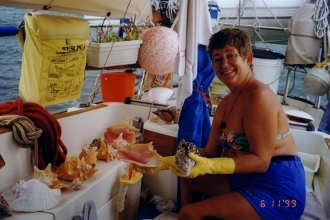

Above Kathy works on her shell collection while John and Eleanor Dinghy about Pipe Creek
By February 10th 1998, we had caught up with Herbie and Barbara and anchored in Pipe Creek on `Dick’s mooring!’ We said hello to June and David at Overyonder Cay. June became our weather lady for our stay in the creek. By mid Feb we had discovered conch on our snorkel expeditions. Brian shaved off his moustache and became known as `the great white hunter’! Herbie and friend Ray enthusiastically showed us all how to clean and cook conch. It’s quite a feat and we netted our fair share of cut fingers. The results were delicious.


One of the resident Swimming Pigs swims out for a treat as Jimmy Buffet anchors in his new power boat beside us at Big Majors which is off Staniel Cay
Sad to leave but anxious to see more, we
moved over to Staniel Cay-mid way down the Exuma chain.
The famous Thunderball Cay contained
a myriad of brightly coloured reef fish all clamouring for our
cheese treats. Staniel has a fair provisioning capacity. At
Adderly Cut we found our friends on Elysium and gammed some more
with them. They are a wealth of information, too.
 Heading south
again Stocking Island was our southernmost
destination. Here we anchored under Stocking Island for the
month of March. To the left is a view of Hamburger
Beach off Stockling Island. Here we enjoyed the
Georgetown Family Sailing Regatta in 1998. The
lead organizer was the owner of Sailorman in Florida who
was present with family in their gorgeous sloop sv/SAILORMAN.
Heading south
again Stocking Island was our southernmost
destination. Here we anchored under Stocking Island for the
month of March. To the left is a view of Hamburger
Beach off Stockling Island. Here we enjoyed the
Georgetown Family Sailing Regatta in 1998. The
lead organizer was the owner of Sailorman in Florida who
was present with family in their gorgeous sloop sv/SAILORMAN.
 The next year the Georgetown
Regatta 1999 proved to be great fun
as well. A myriad of activity was planned and executed by over a
hundred cruising yachts. The conch blowing contest and race
around Stocking Island were great. Nancy and Tom and Yvonne
visited. Beach combing was fascinating. We studied the reefs,
the shells and loved the snorkelling. Two weeks at the end of
April we flew home to satisfy the tax man. As you can see
the photos below will give you an impression of the yachties
having fun at the Regatta.
The next year the Georgetown
Regatta 1999 proved to be great fun
as well. A myriad of activity was planned and executed by over a
hundred cruising yachts. The conch blowing contest and race
around Stocking Island were great. Nancy and Tom and Yvonne
visited. Beach combing was fascinating. We studied the reefs,
the shells and loved the snorkelling. Two weeks at the end of
April we flew home to satisfy the tax man. As you can see
the photos below will give you an impression of the yachties
having fun at the Regatta.

To the right is the female crew who did an excellent job keeping the men entertained durin the race around Stocling Island in the Exumas


Above a Mermaid is Landed

Who likes Mermaids to the right?
TWINKLE TWINKLE LITTLE STAR
A serious skit ABOVE is put on by a mixture of yachtie crew at the Regatta
During our stay in George Town we had visits with Gord Murphy on svInterlude and Bob and Joan on svBacchus. Jerry and Joan managed a visit as well. Below Gord is seen relaxing in the cock pit of Bacchus. Also viewed below is a meal aboard Tundra with guests Jerry and Bob with their spouses the two Joan's


After our stay in Georgetown we returned to the Bahamas
then up the inter coastal to the Chesapeake for
a new engine before returning south to Florida in the fall of
1998 and then off again to the Bahamas early in 1999.
TUNDRA ARRIVES AGAIN IN THE BAHAMAS IN THE WINTER OF 1999
Message From the sailboat Iwanda via HAM email: "Tundra arrived in Nassau today. Brian is trying to fix his SSB that took salt water on their passage from Florida." ("SSB" stands for Single Side Band. It is their HAM radio).
January 9th 1999
Ron and Wendy, Gary and Kayley made an unexpected
week long trip to Nassau, so we had more pressing reasons to
move quickly. As a result we took a short window; offshore,
through the gulf stream, across the banks and down the tongue of
the ocean into Nassau. Bleary eyed, we tied to the customs dock
30 hours later. Marnel and Reflections were alongside. Departing
Miami's Government Cut at 0400 hours was a real treat! We were
dodging cruise ships, fishing tugs, and any number of other
`floatables'. The Gulf Stream was still a little riled so we
were delighted to round North Riding Rock and find the banks
quiet and dolphins welcoming. Navigation became a little tense
as we met a tug and tow at midnight rounding Northwest Light and
falling off into the Tongue of the Ocean. The depthfinder goes
from 15 feet to DEEP (over 200 feet) in a matter of minutes.
Alberg 37 owners will be interested to know that we met
Brandelera and Southern Cross anchored in Nassau. We were
grateful when Marcel helped us set our second anchor and we fell
into bed for some much needed sleep. The following week we
enjoyed company of the Marsh family immensely. Our nine year old
niece, Kayley, became our crew for a good part of the week. She
is a natural on the boat and we look forward to her future
visits. We also were treated to some shore side amenities with
Ron and Wendy. I loved constructing `castle Tobu' of white coral
sand with 8 year old, Gary.Unfortunately we `salted' our amateur
radio coming across and relied on cruising friends for long
distance communication until Lady Bea arrived with our
replacement. We sure had withdrawal symptoms while we couldn't
talk to our early morning 'turkeys'.
January 20th 1999 found us heading east into the Exuma chain. Our first anchorage was at Allan's Cay. This is one home of the Rock Iguana who are prehistoric-looking reptiles. They scurry to meet company and provide much entertainment. Also we were able to do some drift snorkeling with the dinghy. The water is warm and inviting this year. Our next anchorage was at Norman's Cay which is well known for it's 1970-80's drug smuggling history. The ring leader, Carlos Lehder, was convicted in 1988 to life without parole for 135 years! Ruins on the surrounding islands all attest to the colourful history and struggles between the factions involved. We weathered a front here with 20 or so other boats. Dinghying in this area was great fun and we picked up our first conch. The meat is wonderfully sweet, but takes a lot of tenderizing. We enjoyed this with newcomers full of great enthusiasm. All have conch horns for communication within the cruising community now.Weather allowed us a sail further south to Shroud Cay where we dinghied through the salt marshes to the Atlantic beaches. Warm beautiful weather is such a treat and we're anchored quietly in the lea. Great sleeping.
 January 27th
1999 we moved on and entered the Exuma Land and Sea
Park where we picked up a mooring for a few days at Wardwick
Wells. Boat maintenance took up a good part of our stay
here. Caulking several leaks took one morning while Brian
searched out what was ailing our sumlog and it's now back in
working order. In the afternoons we hiked the park trails,
observing loyalist ruins of the 1700's, and studying the flora
and fauna. Under a wonderful full moon, a group of five families
went ashore in the evening for a hutia search. Hutia are small
gerbil-like rodents introduced to the islands by the loyalists.
None were sighted, but the blowholes were awesome and company
most interesting. One of our snorkeling ventures provided
lobster sightings-our first ever in the water and so
exciting. Above left we can be seen on the top of Boo Boo Hill
where visiting Yachties leave a named souvenier so other
visiting yachties can recognize your past presence here.
January 27th
1999 we moved on and entered the Exuma Land and Sea
Park where we picked up a mooring for a few days at Wardwick
Wells. Boat maintenance took up a good part of our stay
here. Caulking several leaks took one morning while Brian
searched out what was ailing our sumlog and it's now back in
working order. In the afternoons we hiked the park trails,
observing loyalist ruins of the 1700's, and studying the flora
and fauna. Under a wonderful full moon, a group of five families
went ashore in the evening for a hutia search. Hutia are small
gerbil-like rodents introduced to the islands by the loyalists.
None were sighted, but the blowholes were awesome and company
most interesting. One of our snorkeling ventures provided
lobster sightings-our first ever in the water and so
exciting. Above left we can be seen on the top of Boo Boo Hill
where visiting Yachties leave a named souvenier so other
visiting yachties can recognize your past presence here.
Moving Tundra to the Park Bell Island anchorage, we snorkeled the Sea Aquarium, which is nothing short of magnificent. Every possible kind of coral and fish abound - large and small. Swimming through masses of sergeant major fish was great fun. The winds picked up and so did we.
Next am we beat our way to Staniel Cay
area and anchored behind good friends, Murray and Heather on
Windswept 1V, originally from Chatham. Here in Big
Majors Spot, Brian donned scuba gear and replaced our
almost non-existent zincs. Provisions are plentiful here and we
even had some laundry done. Because it has been so hot and dry,
water is not plentiful. The local people are very accommodating
and pleasant. Ashore in this anchorage we have a Miss
Piggy. She is a friendly pig who loves cruisers
biodegradables. When she hears one coming she swims out to meet
the dinghies! Yes, a swimming pig. Miss Piggy is viewed in the
photos above on this page.We loved our Christmas mail from all
you wonderful people and really look forward to your
correspondence. We are not able to receive attachments or
graphics from the Internet, so please send us your text only-no
attachments. Our next email stop will be Georgetown in perhaps a
month. We've just met up with Marnel again and are backtracking
slightly to do some drift snorkeling. Each of us holds a line
from the dinghy and we drift with the currents over the reefs.
We'll be in the Staniel area until we can't find anymore to do
and see. You can imagine when that will be! Yesterday we treated
ourselves to another snorkel through the famous James
Bond Thunderball Cave just off Staniel.With
exceptionally quiet weather for this time of year we decided to
backtrack to Compass Cay. Here we could enjoy the beauty of
Exuma National
Park as well as catch a conch dinner out of the park boundaries.
All a short dinghy ride away.
February 9 1999
Our first day found us snorkeling a sensational
elkhorn coral garden off the southern tip of Cambridge
Island, then swimming into two sensational caves in
the Rocky Dundas area. The stalagmites and stalactites were
magnificent with exceptional colouring, highlighted by open air
ceilings. Next day we drift snorkeled an open reef in the park.
Corals of all description and colour entertained us; brain, pipe
organ, lettuce, gorgonians, sea fans, elkhorn, staghorn and
more. We come home and study all the fishes and corals each
evening. Our last day we hiked Cambridge Island
over to Bell Rock. The Park has labeled a lot
of the flora along the trail. Views of the ocean and surrounding
reefs were exceptional. In sharp contrast to last year, the
water is warm and the days are sunny and quiet. Last year's
fronts are few and far between. Noseums are a nuisance when all
is quiet, so our screens are a blessing. We don't go ashore
early or late in the day.Yesterday we reluctantly hauled anchor
and headed for Black Point via Exuma
Sound and Dotham Cut, where we
re-entered the bank area. Hopeful we were of catching a nice
dolphin fish, but of no avail. Marnel trailed 4 lines and
ourselves, 2. Maybe next time.
The Black Point community is very friendly. I was delighted to
tour one local citizen's 'garden of eden'. He is growing many
fruit trees; papaya, native apple, tamarind, almond and more:
plus vegetables, indigenous to the area; calloo (like lettuce),
chick peas, sweet potatoes, etc. This industrious man is the
first person who we have seen composting and attempting
agricultural pursuits, other than onions and bananas.Here we
will reprovision with a few items and take on water. Water
collection has been almost non existent as we've had very little
rain.Speaking of foodstuffs, Canadians will be very interested
to know that wonderful flour from Canada is used here by all.
I've just discovered a new sourdough recipe and am having great
fun with it. It's ideal for cruisers as there are not too many
dishes involved, and the dough rises quickly in the warm
Bahamian sun.
RECIPE FROM THE GALLEY OF TUNDRA
SOURDOUGH BREAD FROM TUNDRA
STARTER
 Mix 2 cups of water in
which potatoes have been boiled with 2 cups of flour (hard,
unbleached, white, available in health stores is best) and one
tablespoon of sugar. Cover mixture loosely, stir it once a day,
and let it sit in a warm spot for three or four days. When it
starts to bubble merrily and lets off a sour odour that is not
all unpleasant, it is ready to use. If practical, store it in
the refrigerator. Feed it by adding a half cupful each of flour,
and water, and a teaspoon of sugar every two weeks. If stored in
a warm spot feed it more frequently. In any event, do not let it
freeze or be heated beyond lukewarm. When stored the sourdough
may appear dormant, a crust or a liquid may form at its top.
Have no concern. As soon as it is fed and warm it will come to
life and start bubbling again. Don't ever put a tight lid on
your sourdough. The stuff is alive and when confined just might
burst out making an awful mess.
Mix 2 cups of water in
which potatoes have been boiled with 2 cups of flour (hard,
unbleached, white, available in health stores is best) and one
tablespoon of sugar. Cover mixture loosely, stir it once a day,
and let it sit in a warm spot for three or four days. When it
starts to bubble merrily and lets off a sour odour that is not
all unpleasant, it is ready to use. If practical, store it in
the refrigerator. Feed it by adding a half cupful each of flour,
and water, and a teaspoon of sugar every two weeks. If stored in
a warm spot feed it more frequently. In any event, do not let it
freeze or be heated beyond lukewarm. When stored the sourdough
may appear dormant, a crust or a liquid may form at its top.
Have no concern. As soon as it is fed and warm it will come to
life and start bubbling again. Don't ever put a tight lid on
your sourdough. The stuff is alive and when confined just might
burst out making an awful mess.
PREPARATION
Measurements do not have to be exact. Only one
ovenproof bowl is needed for mixing, rising and baking. Use
plastic or glass utensils. Try to keep all warm.
First Step
Extend your starter by mixing in another 2 cupfuls each
of flour, potato water or water, plus a tablespoon or more of
sugar. Sugar is an important ingredient in the rising factor, so
do not skimp or eliminate it.) Put the starter in a warm place
and let it stand for a few hours or even a day or two.
Second Step (Optional)
More fun, but not essential! For basics, skip to the
third step.
1. Whole wheat bread.Try bran and white flour. Soften the bran
by boiling the bran in liquid or pouring boiling water over it.
Otherwise the sharp edges of the bran may allow the bubbles to
escape and impede rising. Use half cup of bran to two cups of
starter.
2. After softening the bran, try adding a quarter of a cup of
molasses and a blob of butter so they, too, will soften in the
warmth of the mixture.
3. Also, for whole wheat, try boiling the bran in a cupful of
tomato juice or stewed tomatoes and adding herbs, or in peach
and apricot juice and adding peel and nuts, or in a cupful of
crushed pineapple and adding shredded coconut or in cranberry
sauce or mincemeat. Let your imagination be your guide!
4. You may wish to eliminate bran and add raisins, currants,
(rolled in flour first), nuts, peel, cinnamon, grated cheese and
herbs, or simply more water to increase the quantity of bread.
Third Step
Pour half the starter into a bowl. It is best if it
feels slightly warm to touch. Add salt if you choose. Keep
adding flour, mixing it first with a spoon and then with the
palm of your hands. Knead by pushing the outer edges of the
dough down into the centre. By the time you've given 50 punches,
the dough will have absorbed almost as much of the flour as it
can hold and very little more is required to keep the dough from
sticking to your fingers. Keep on kneading for a total of about
200 punches. Remove the dough or push it from side to side and
carefully butter the whole of the inside of the bowl. If you
prefer, use bread pans and form loaves or makes buns of any
variation. Put the pans or bowl in a warm, not hot, draft free
place. Put unused starter back in the fridge.
Fourth Step
Depending on warmth, humidity, etc, rising times will
vary from several hours to as much as 24 hours. Dough will
double or triple in size. Heat oven to 375 degrees and bake the
bread 35 to 45 minutes. It should sound hollow if rapped with
your knuckles. Give it half an hour and enjoy.
February 18, 1999.
From Black Point we sailed a short distance
south of White Point to rendezvous with Shady
Lady. Bill and his brother treated us to a fresh fish dinner and
it was nice to meet 'an old friend' again. As another cold front
was threatening clocking winds, Marnel and Shady Lady and Tundra
backtracked north to the protected waters of Pipe Creek.
Here we snorkeled and fished and conched, plus Brian and I
addressed more maintenance. We caulked a few deck fittings,
rebedded the hatch gaskets, and repaired our dinghy oars.Pete is
taking his amateur radio exam in Georgetown on the 22nd so we
hiked out of Pipe Creek on a rising tide. The entrance is a
little shallow over the banks and the Sound has been too rough
for a comfortable exit through the cuts. Our sail down to Galliot
Cay was pleasant in spite of a slight beat to weather.
Snorkeling here proved beautiful, but the winds were starting to
strengthen again with an impending front. Next am we were
rocking and rolling, so rather than beat into head seas we moved
on down the inside of Cave Cay to sit comfortably behind Musha
Cay in preparation for a run for Georgetown. Herb,
NMN, our weather guru was preparing us for clocking winds.
Westerlies are great for a run south. Today, February 17th, the
winds were relatively quiet, so we slipped out of Cave Cay Cut
early, 0730, and headed south. What a great day. Fishing was the
hit of the day. Dolphin fish were out prime target, but they did
a dandy job of evading us. Tundra came in with a mackerel and a
oceanic bonito, similar to tuna. The bonito gave us a great
fight. Both were a little over a foot long. By the time we got
them cleaned, the pickings on the mackerel were slim. The tuna
is quite fat and meaty. We'll have tuna salad tomorrow. Time
passes quickly when you're having fun. Georgetown
has a record number of cruisers here for regatta week - 450+.
Welcome voices on the VHF were Don and Barb on Sherlock and
Karen and Marcel on Southern Cross. At 1430 we ploughed the
anchor in at Hamburger Beach. Our favourite place to be. The
hamburger stand on shore has been painted super bright colours
and a new dock has been installed. Competition from Volleyball
Beach has obviously been recognized. It's a little sad to see
paradise gradually becoming more commercialized each year. A
response to American standards?
February 23rd 1999
Reprovisioning and hauling water kept us busy for a few
days. We were able to enjoy a great day of snorkeling the south
cut before another front blew through. Peter got his
technician's license so will now study code - another amateur
radio buff launched. Shelling is wonderful and Brian has just
finished Chesapeake.
March 10th 1999
With over 420 boats registered for the 19th Annual
Cruising Regatta, Georgetown is brimming over with excitement
and entertainment. We are anchored on the outskirts where all is
a little quieter than the center of hustle and bustle. Several
good snorkeling expeditions took us to Channel Cay and Fowl Cay
at the far ends of the Stocking Island Harbour.
Regatta Week sported sailing racing events, a scavenger hunt,
tennis tournaments, baseball games, sand sculpting contests,
volleyball playoffs, plus lots of native food. The highlight for
us was crewing on a Manta 40 catamaran. What a beautiful machine
and Brian enjoyed being helmsman all the way. Brian and I have
enjoyed some good hikes along the island plus meeting a few more
cruising couples. Weather has been wonderful overall and the
water warm. Please note the photos above showing the crew on the
Manta 40 catamaran "PANGEA"
We are back to provisioning again and must fill up with potable
water in our on board tanks. Rain has been super scarce this
year. Enjoy the luxury of plentiful fresh water, all ye
landlubbers. It costs $1.00 a GALLON out here! Later this week
we will weigh anchor and sail to the out islands for some peace
and quiet. Long Island is on our route south to the Jumentos and
the Crooked Acklins. Here we hope to do some great fishing,
snorkeling and diving for a few weeks.
On March 10th 1999 we made
positive motions re moving out of Georgetown.
We hauled and took on 40 gallons of reverse osmosis water and
bought as many bananas, oranges and tomatoes as we could hold.
Swiss Cheddar cheese is a wonderful product here and not too
expensive. Also butter from New Zealand is very good and
available. Three dozen non refrigerated eggs for the bilge,
rotated daily. One chicken, a few pork chops, and some ground
chuck went into the freezer. Four 5 lb plastic bags of great
Canadian flour rounded out the compliment of food.

 On March 11th
1999 we picked up our mail from Exumas Market, weighed anchor,
and sailed for Thompson Bay, Salt Pond on Long Island
in company with Marnel IV. It was interesting winding our way
around the sand bores. At times, there was as little as a foot
under the keel. This has a tendency to keep one quite alert at
the helm! It was a comfortable overnight anchorage en route to
the Comer Channel and the Jumentos. During a
short hike on shore we enjoyed seeing the famous Blue
Hole of Long Island. Also notice the beautiful Bahamian
beaches that Long Island has to offer.
On March 11th
1999 we picked up our mail from Exumas Market, weighed anchor,
and sailed for Thompson Bay, Salt Pond on Long Island
in company with Marnel IV. It was interesting winding our way
around the sand bores. At times, there was as little as a foot
under the keel. This has a tendency to keep one quite alert at
the helm! It was a comfortable overnight anchorage en route to
the Comer Channel and the Jumentos. During a
short hike on shore we enjoyed seeing the famous Blue
Hole of Long Island. Also notice the beautiful Bahamian
beaches that Long Island has to offer.

 Another spectacular site
on Long Island is the Blue Hole. It is
probably the most beautiful one in the Bahamas
Another spectacular site
on Long Island is the Blue Hole. It is
probably the most beautiful one in the Bahamas
Shady Lady was waiting for us on the banks and was a pretty sight with all sails set when we rendezvoused. Several other boats, ROCKHOPPER and ANTIGOON, accompanied us for out first week, as well. Our first anchorage was Water Cay. Coral heads abound and are wonderful for snorkeling, but definitely add a point of challenge to our navigating. The heads are loaded with fish and the ocean feeds us easily. This chain of Cays is 110 miles long and rounds slightly in a semi circle from northeast to southeast providing good protection from the prevailing easterlies. Only several anchorages provide protection from weather fronts, so we are watching the weather patterns carefully. We check in with our amateur radio Waterway Net and turkey net regularly. The islands are uninhabited except for Duncan Town at the southern end with a population of 100 people and a fishing outpost on Jamaica Cay manned by 2 sons of an entrepreneur in Duncan Town. Most cays have resident wild goats, some chickens and one reports a horse. We rarely see the goats,but see lots of scat and can hear them, so we feed them our biodegradables.
Our first Island in the Jumentos was Water Cay and below you can see us in our dinghy exploring a cave here. the fishing and snorkling here was unbelievable!!
 From Water Cay
we headed out to the deep water of the The Crooked
Island Passage and fished our way down to Racoon
Cay where we reentered the banks via the Nurse
Channel. At 40 feet I snagged a mighty big fish. It was great
fun playing it for a half hour. I had 100 lb test line on with a
wire leader, so the fight was on! Within about 20 feet of Tundra
it decided it was going the other way and that was that. The
leader was chewed to bits and the hook on my lure was
straightened as it disappeared. All we saw was a big mouth and
some dorsal fins. Great fun. Pete and Lani thought it may have
been a sailfish or marlin.
From Water Cay
we headed out to the deep water of the The Crooked
Island Passage and fished our way down to Racoon
Cay where we reentered the banks via the Nurse
Channel. At 40 feet I snagged a mighty big fish. It was great
fun playing it for a half hour. I had 100 lb test line on with a
wire leader, so the fight was on! Within about 20 feet of Tundra
it decided it was going the other way and that was that. The
leader was chewed to bits and the hook on my lure was
straightened as it disappeared. All we saw was a big mouth and
some dorsal fins. Great fun. Pete and Lani thought it may have
been a sailfish or marlin.

 For
several days we explored loyalist ruins at Racoon Cay and walked
the beaches before hunkering down for an impending cold front at
the southern end. Here we snorkeled and rolled a little as the
front went through, then headed off down to Duncan Town
on Ragged Island to see the
village. Along side are a couple of photos
illustrating this remote town in the Southern Bahamas. Conch are
hung to dry on a clothes line shown as above.
For
several days we explored loyalist ruins at Racoon Cay and walked
the beaches before hunkering down for an impending cold front at
the southern end. Here we snorkeled and rolled a little as the
front went through, then headed off down to Duncan Town
on Ragged Island to see the
village. Along side are a couple of photos
illustrating this remote town in the Southern Bahamas. Conch are
hung to dry on a clothes line shown as above.


 A beach restaurant
constructed around a DC 3 crash provided a lovely meal out for
us. Our Bahamian hosts, Percy and Jill, served us wonderful
meals of conch and grouper, potato salad, coleslaw, peas and
rice, and pickled beets. The shore side abodes were guarded by
watch dogs and it was necessary to call ahead as they were
chained and fenced! We walked the one and a half miles into the
town, visited with the locals, and found only canned provisions.
Their fresh fruit and vegetables and R/O water arrive on the
mailboat, Mannana, weekly. They must order all the week before.
Of particular interest was their method of preserving conch. It
was heavily salted and hung to dry on their clotheslines. There
is a defunct salt industry here which closed down when the last
hurricane destroyed most of the sight, plus the residents
houses. The population diminished to 100 from 500 as a result.
We visited the local school to find smartly uniformed children
from grade one through twelve and a pleasant teaching couple
from French Guyana. Our restaurant hosts escorted us to the
conch grounds on their 'seadoo!' and showed us their method of
cleaning conch. Percy said that he can clean 800 in one day!
Amazing! Snorkeling the reefs here netted us some lobster and
fish. Brian got his first lobster as a nurse shark about my size
swam by! Supposedly they're harmless, but he kept it out of the
water beautifully, so as not to attract it. The sharks come into
shallow water to mate at this time of year, so we have our eyes
peeled and are seeing quite a number.
A beach restaurant
constructed around a DC 3 crash provided a lovely meal out for
us. Our Bahamian hosts, Percy and Jill, served us wonderful
meals of conch and grouper, potato salad, coleslaw, peas and
rice, and pickled beets. The shore side abodes were guarded by
watch dogs and it was necessary to call ahead as they were
chained and fenced! We walked the one and a half miles into the
town, visited with the locals, and found only canned provisions.
Their fresh fruit and vegetables and R/O water arrive on the
mailboat, Mannana, weekly. They must order all the week before.
Of particular interest was their method of preserving conch. It
was heavily salted and hung to dry on their clotheslines. There
is a defunct salt industry here which closed down when the last
hurricane destroyed most of the sight, plus the residents
houses. The population diminished to 100 from 500 as a result.
We visited the local school to find smartly uniformed children
from grade one through twelve and a pleasant teaching couple
from French Guyana. Our restaurant hosts escorted us to the
conch grounds on their 'seadoo!' and showed us their method of
cleaning conch. Percy said that he can clean 800 in one day!
Amazing! Snorkeling the reefs here netted us some lobster and
fish. Brian got his first lobster as a nurse shark about my size
swam by! Supposedly they're harmless, but he kept it out of the
water beautifully, so as not to attract it. The sharks come into
shallow water to mate at this time of year, so we have our eyes
peeled and are seeing quite a number.
ANTIGOON and ROCKHOPPER departed north on the 18th. We three remaining boats moved north to Hog Cay on the 21st. Here we met another cruiser heading for Cuba, only 60 miles south. He took us out bone fishing on the flats and we all participated in a shore dinner of fish and potluck.
 The Bahamian drug
enforcement agency is very active is this area and we have seen
several military helicopters maneuvering overhead. One night was
particularly exciting between flashing lights, speeding
powerboats and unlit helicopters. We ignore everything. Hear no
evil, see no evil, do no evil. A thunder and lightening storm
produced some much needed rain water for us one night. What a
blessing as it's been super dry. I spent most of the night
collecting water and did a much needed wash the next morning.
The Bahamian drug
enforcement agency is very active is this area and we have seen
several military helicopters maneuvering overhead. One night was
particularly exciting between flashing lights, speeding
powerboats and unlit helicopters. We ignore everything. Hear no
evil, see no evil, do no evil. A thunder and lightening storm
produced some much needed rain water for us one night. What a
blessing as it's been super dry. I spent most of the night
collecting water and did a much needed wash the next morning.

 Diving
and fishing keep our days very active, plus excursions ashore.
Here Kathy and I did our first serious Bone Fishing.
One such hike, we found our way, via a loyalist rock fence,to
the ocean side and snorkeled a beautiful, protected reef. It is
great fun beach combing the Atlantic beaches. Brian teasingly
refers to them as the hardware store. One finds it hard to
believe what is washed up on shore.On the 24th we moved up to
House Bay on Racoon Cay. Lani and I conched until we were
exhausted. I made a fish stew of lobster, conch and snapper. It
was so rich we could only eat one bowl, with homemade rolls, of
course. An expedition to a blue hole inland with fishing poles
in hand, netted no fish, but proved very interesting. Poison Wood
is rampant here so we hike with caution. A dinghy expedition to
the north end of the island revealed some beautiful heads to
snorkel. This was the day of the glass eye snapper and we all
feasted royally. The sharks and barracudas enjoyed our fish
cleaning session.
Diving
and fishing keep our days very active, plus excursions ashore.
Here Kathy and I did our first serious Bone Fishing.
One such hike, we found our way, via a loyalist rock fence,to
the ocean side and snorkeled a beautiful, protected reef. It is
great fun beach combing the Atlantic beaches. Brian teasingly
refers to them as the hardware store. One finds it hard to
believe what is washed up on shore.On the 24th we moved up to
House Bay on Racoon Cay. Lani and I conched until we were
exhausted. I made a fish stew of lobster, conch and snapper. It
was so rich we could only eat one bowl, with homemade rolls, of
course. An expedition to a blue hole inland with fishing poles
in hand, netted no fish, but proved very interesting. Poison Wood
is rampant here so we hike with caution. A dinghy expedition to
the north end of the island revealed some beautiful heads to
snorkel. This was the day of the glass eye snapper and we all
feasted royally. The sharks and barracudas enjoyed our fish
cleaning session.

On the 25th 1999 we moved north
to Buena Vista Cay. Here we have a mile and a half long beach to
anchor off and explore great coral heads, hikes inland, and
enjoy peace and quiet. The lobster fishermen are hauling their
pots for the season and one can't believe how many they can get
in one small outboard boat.Here we've been able to do some
maintenance again. Tundra's bottom got a good scrub including
removal of a few barnacles. The water is wonderfully clear. Line
fishing for margate, a type of grunt, rivals bass fishing up
north.A couple of local fisherman sold us lobster when we first
arrived so we hail them regularly to see their catch. They're
most friendly and proud of their accomplishments. I was totally
surprised when they pulled up alongside with their hunting
results a couple of days ago. They had shot a family of
goats-three large and one little. Of course they will use the
total animal amongst the community right down to the stomach,
one explained.
As the prevailing northeast trade winds have been exceptionally
heavy we have layed over here a relaxing week. Only tonight,
April 1st, have they let up and we plan a move to Jamaica Cay
tomorrow.
Bill and Colleen on Shady Lady left for Florida on Monday and
had a fast non stop two day trip to Miami. We
kept in contact with them by radio as they sailed over the banks
through the Old Bahamas Channel and up into the Gulf
Stream back to the mainland. Now we're down to two
boats and becoming quite keen with regards to water
conservation, meal preparation, etc.
Friday, April 2nd 1999
 Happy Easter
all. We are thinking of you. This am the weather quietened off.
Low and behold, the rooster is crowing and the goats baa-ing, so
our spirits were cheered as we weighed anchor for
Jamaica Cay. Here, Percy's sons welcomed us, plus 3
other boats, ashore for a tour of their small cay. The mainstay
of their existence is based on diving conch and trapping fish,
mostly laine snapper, to be transported on the mail boat to
Nassau. There is an awesome blue hole just off the cay which we
observed through our look bucket. Marvin said it abounds with
shark so we fished rather than snorkeled it. Shelling and
snorkeling here was wonderful. Marvin agreed to take us on one
of his fishing excursions, so all 4 of us loaded into his open
Carolina skiff with an ailing 90 horsepower engine which he hand
started! 0830 found Brian and Pete diving 30 feet for conch. He
used these for bait in his fish trap. We cruised the coral heads
with Marvin checking out the fish with his snorkel mask over the
side. Basics sure work and he was a fine example of simple, but
profitable living. Once we got the fish trap set to his
satisfaction, he took us to several other heads to fish and
snorkel. In 30 feet, Pete speared a lovely big grouper and a
good sized margate with Brian helping on the retrieval. The
corals are magnificent. It was amazing to see the beautiful
catch that came up in his trap. It included any number of
snapper, plus many other good eating fish and a frisky eel.
Discarding the eel, we headed for the anchorage. Marvin,
navigating by sight, was very careful not to get out of sight of
land at any time. We tried some laine snapper and a porgy ( only
for a meal or too, as our refrigeration is limited), Marnel took
grouper and trigger, and the rest was destined for the mailboat.
What a super experience.On brother Johnny's 60th birthday,
Happy Easter
all. We are thinking of you. This am the weather quietened off.
Low and behold, the rooster is crowing and the goats baa-ing, so
our spirits were cheered as we weighed anchor for
Jamaica Cay. Here, Percy's sons welcomed us, plus 3
other boats, ashore for a tour of their small cay. The mainstay
of their existence is based on diving conch and trapping fish,
mostly laine snapper, to be transported on the mail boat to
Nassau. There is an awesome blue hole just off the cay which we
observed through our look bucket. Marvin said it abounds with
shark so we fished rather than snorkeled it. Shelling and
snorkeling here was wonderful. Marvin agreed to take us on one
of his fishing excursions, so all 4 of us loaded into his open
Carolina skiff with an ailing 90 horsepower engine which he hand
started! 0830 found Brian and Pete diving 30 feet for conch. He
used these for bait in his fish trap. We cruised the coral heads
with Marvin checking out the fish with his snorkel mask over the
side. Basics sure work and he was a fine example of simple, but
profitable living. Once we got the fish trap set to his
satisfaction, he took us to several other heads to fish and
snorkel. In 30 feet, Pete speared a lovely big grouper and a
good sized margate with Brian helping on the retrieval. The
corals are magnificent. It was amazing to see the beautiful
catch that came up in his trap. It included any number of
snapper, plus many other good eating fish and a frisky eel.
Discarding the eel, we headed for the anchorage. Marvin,
navigating by sight, was very careful not to get out of sight of
land at any time. We tried some laine snapper and a porgy ( only
for a meal or too, as our refrigeration is limited), Marnel took
grouper and trigger, and the rest was destined for the mailboat.
What a super experience.On brother Johnny's 60th birthday,
April 6th 1999, we said goodbye
to Marvin and Jurass, setting sail north to Flamingo Cay. Here
we had some difficulty setting our anchor in hard coral sand.
While diving the anchor a largish, lurking barracuda sent me
flashing for the dinghy. Needless to say, we finished the job
from Tundra. Here we explored, snorkeled, and hiked. One
beautiful beach looked as if it had been recently burned - a
reminder to douse our fires thoroughly. It has been so dry that
the islands are really threatened with careless behaviour. Our
fires are mainly to reduce garbage, so glass and burned,
condensed cans are the only items we carry along. The weather
fax is invaluable here as most of the Jumentos offer only lee
anchorages and it's no place to be caught in a front with the
winds clocking. April 8th we dropped anchor in south Water Cay
anchorage. The scenery here is breathtaking. White limestone
cliffs, eroded with time, drop into crystal-clear water. Lovely
hikes on the ridge provided breathtaking scenery and, of course,
the Atlantic beaches presented another hardware store as always.
We found a great fish bucket for the dinghy. Many reefs surround
the island. One, in particular, is called Trigger Fish Reef.
Here Pete and Lani caught a bucketful of triggers in half an
hour, so we all went back to snorkel it. Sea life abounds and
spearing produced several more grouper. This has provided
breakfast, lunch and dinner for quite a number of days. One
incident in particular had us in stitches. Brian released his
spear and while I was retrieving it, a beautiful trigger fish,
curious as ever, bumped into my spear. They are brightly
coloured fish with a lovely smile on their face. I love to swim
with them.April 10th we sailed up the Comer Channel with a foot
under the keel at times and back into Salt Pond, Long Island.
What a wonderful month in the Jumentos and
now it's time to make a few phone calls and reprovision. Long
Island has a population of 350 people and is 75 miles
long. For the past several days we've been touring the island by
car. At the northern tip is Cape Santa Maria
sporting a monument to Christopher Columbus with a spectacular
view of surroundng reefs. The Cape is named after his flagship
which ran aground here. Farming and fishing support the island
economy. Lobster fishing is particularly lucrative. Another
fascinating area was a blue hole touted as the World's Deepest
Blue Hole measured to 660 feet. The surrounding area in Turtle
Cove is being developed by Canadians. Salt Pond, close to our
anchorage, supports a good part of the population. Our lunch
stop was a quaint lovely building on the salt marsh with tarpon
and bone fish swimming lazily off the front deck. The atmosphere
was so interesting with mounds of sponges next door.
April 23rd 1999
Some supplies were available at Kay's Last Chance
Grocery Store, so we stocked up on carrots, tomatoes, and even a
few grapefruit. (imported on the mail boat). Southeast winds,
piping, produced an uncomfortable roll in the anchorage so we
moved to the northwest side of the island. Flamingo Bay
presented quite a challenge navigating around the entrance
reefs. Good light over one's shoulder is a necessity to get in.
If one is faint of heart, don't attempt it! Snorkeling on the NW
reef is exceptional with great columns of coral everywhere, some
resembling statues. Hartford Cave in this area displays some
early Lucayan lore. We found out later from other cruisers it's
exact location. Unfortunately we searched and couldn't locate
it, so we'll have to return. This island reportedly supports a
Brahma bull population. While exploring loyalist ruins, we
encountered their tracks-huge-but never saw them. Very often
ruins are surrounded by coconut palms exposing their location.
Carefully picking our way out of the reefs in brilliant sunshine
and perfect conditions, we sailed for San Salvador on the 25th.
Whales, we think humpbacks, gave us a lovely display en route.
Marnel caught a cow and bull dolphin fish which we all cleaned
upon arrival. Yummy!
 San Salvador
was the easternmost point of our cruise and a truly fascinating
island. We spent several days anchored off Cockburn
Town, the capital, before being forced into the one
and only Riding Rock Marina with westerly blows. Here we tied up
to a wall under construction and were glad of even that. It
poured rain, much to everyone's delight; but produced 'lake
Tundra' on the other side of our cement block mooring wall. For
several days we dinghied to the gas dock to go ashore!!!! And,
of course, that brought out the mosquitoes and noseums in full
force. Never mind the weather, we met many friendly and
interesting people, onshore and from our cruising community.The
island is unique in that here Christopher Columbus discovered
the new world in 1492. The Bahamian population of less than 1000
people are friendly, honest and fiercely protective of their
heritage. Several other out islands have laid claim to the first
landing and in our discussion re this fact we were promptly
informed by one of our lovely hostesses, Peaches, that San Sal
was undoubtedly 'THE' spot! Peaches, one of 13 siblings became
our fount of local knowledge. After meeting her we went across
the road to a small lunch restaurant, Carter's snack bar, the
next day. The waitress looked just like Peaches, so I said "You
must be Peache's sister". She said very proudly, "No, I am
Peaches"! The local population are very industrious and many
hold down more than one job.The island is quite prosperous due
to the presence of a lovely Club Med and the Riding Rock Inn. Club
Med entertained many french Canadians and seems that
it would be a perfect spot to spruce up your french. Treating
ourselves to dinner there one evening was an extravagant
experience. The food was unparalleled in quality or quantity.
Our RR Inn catered mainly to scuba diving tours. When the water
had settled down and cleared, we joined them for a dive of the
nearby drop off area. All around the island the water drops from
50 to 60 feet to 7 and 8000 feet, so the wall dives are
spectacular. The corals were spectacular, many canyons and
tunnels. As we hadn't been diving for some time we stuck pretty
close to our guide, George, a young man from Cape Breton Island.
Along with Marnel and Dannie from Lena Mae we rented a car for a
day to tour the sites. Again, the Queen's highway took us around
the circumference of the island with Brian driving on the left
hand side of the road. (British precedents are still very much
in evidence despite the fact that the Bahamas have been an
independent nation since 1986.) The north end sports a marine
biology facility and we observed the students on their daily
field trips. The Dixon Lighthouse was another fascinating stop.
Eighteenth century technology was in beautiful operating
condition. Eight thousand pound fresnel lenses float in a pool
of mercury and are lit by kerosene vapour firing a pre-heated
mantle. The lighthouse keeper had to wind by winch a seven
hundred pound weight the height of the tower every two hours to
rotate these lenses. Only 3 of these hand wound lighthouses are
in existence in the world today at San Sal, Hopetown, and Great
Inagua in the Bahamas.The Dixon cave was about a mile hike
through the underbrush and sported bats and many tunnels.
Needless to say we didn't venture very far inside, but this is
typical of the saltpond islands. Caverns and caves are plentiful
and it would be a spelunker's paradise.The Columbus monument was
a must on the tour and equally impressive at the same site, was
a monument constructed by the Mexican government in honour of
hosting the first Olympic Games in the new world. Apparently the
flame came via Christopher Columbus' route, thus San Sal.Dannie
patiently tutored us all in Spanish and cooked us a Texas style
breakfast one morning. Newfound friends on Mayuc, Ian and
Katherine, entertained us royally with B C smoked salmon, and
all. We all took another guided tour with the Inn and visited
their local museum. Loyalist, Lucayan and Columbus history and
facts were fascinating.
San Salvador
was the easternmost point of our cruise and a truly fascinating
island. We spent several days anchored off Cockburn
Town, the capital, before being forced into the one
and only Riding Rock Marina with westerly blows. Here we tied up
to a wall under construction and were glad of even that. It
poured rain, much to everyone's delight; but produced 'lake
Tundra' on the other side of our cement block mooring wall. For
several days we dinghied to the gas dock to go ashore!!!! And,
of course, that brought out the mosquitoes and noseums in full
force. Never mind the weather, we met many friendly and
interesting people, onshore and from our cruising community.The
island is unique in that here Christopher Columbus discovered
the new world in 1492. The Bahamian population of less than 1000
people are friendly, honest and fiercely protective of their
heritage. Several other out islands have laid claim to the first
landing and in our discussion re this fact we were promptly
informed by one of our lovely hostesses, Peaches, that San Sal
was undoubtedly 'THE' spot! Peaches, one of 13 siblings became
our fount of local knowledge. After meeting her we went across
the road to a small lunch restaurant, Carter's snack bar, the
next day. The waitress looked just like Peaches, so I said "You
must be Peache's sister". She said very proudly, "No, I am
Peaches"! The local population are very industrious and many
hold down more than one job.The island is quite prosperous due
to the presence of a lovely Club Med and the Riding Rock Inn. Club
Med entertained many french Canadians and seems that
it would be a perfect spot to spruce up your french. Treating
ourselves to dinner there one evening was an extravagant
experience. The food was unparalleled in quality or quantity.
Our RR Inn catered mainly to scuba diving tours. When the water
had settled down and cleared, we joined them for a dive of the
nearby drop off area. All around the island the water drops from
50 to 60 feet to 7 and 8000 feet, so the wall dives are
spectacular. The corals were spectacular, many canyons and
tunnels. As we hadn't been diving for some time we stuck pretty
close to our guide, George, a young man from Cape Breton Island.
Along with Marnel and Dannie from Lena Mae we rented a car for a
day to tour the sites. Again, the Queen's highway took us around
the circumference of the island with Brian driving on the left
hand side of the road. (British precedents are still very much
in evidence despite the fact that the Bahamas have been an
independent nation since 1986.) The north end sports a marine
biology facility and we observed the students on their daily
field trips. The Dixon Lighthouse was another fascinating stop.
Eighteenth century technology was in beautiful operating
condition. Eight thousand pound fresnel lenses float in a pool
of mercury and are lit by kerosene vapour firing a pre-heated
mantle. The lighthouse keeper had to wind by winch a seven
hundred pound weight the height of the tower every two hours to
rotate these lenses. Only 3 of these hand wound lighthouses are
in existence in the world today at San Sal, Hopetown, and Great
Inagua in the Bahamas.The Dixon cave was about a mile hike
through the underbrush and sported bats and many tunnels.
Needless to say we didn't venture very far inside, but this is
typical of the saltpond islands. Caverns and caves are plentiful
and it would be a spelunker's paradise.The Columbus monument was
a must on the tour and equally impressive at the same site, was
a monument constructed by the Mexican government in honour of
hosting the first Olympic Games in the new world. Apparently the
flame came via Christopher Columbus' route, thus San Sal.Dannie
patiently tutored us all in Spanish and cooked us a Texas style
breakfast one morning. Newfound friends on Mayuc, Ian and
Katherine, entertained us royally with B C smoked salmon, and
all. We all took another guided tour with the Inn and visited
their local museum. Loyalist, Lucayan and Columbus history and
facts were fascinating.
With clear weather we hauled our anchors on May
6th 1999 for a passage to Cat Island. With a rendezvous planned
with the Hansens from Sarnia in mid-May we moved up islands
quickly. Anchorages included Little San Salvador, Cat
Island, and Eleuthera. While in Hatchet Bay,
Eleuthera, amidst a storm, a companion boat was struck with
lightening, resulting in major equipment failure. They were only
100 feet from us and lost their computers, self-steering, radar,
radios, and more. This is apparently fairly consistent with
summer weather in the Bahamas. Also, while here, we met two
other Alberg 37's- Nancy and Nicolas on Nancy Mae and Lee on
Mondia 1V.
 In Spanish
Wells we were pleasantly surprised to find Jill and
Jennifer Doherty at their island residence and had a wonderful
visit ashore. Before leaving the area we booked passage on the
mail boat, Eleuthera Express, to Harbour Island and back. The
route is strewn with reefs and treacherous so this was a very
comfortable and relaxing look at the route. Brian took GPS way
points all the way, but I'm not sure we'd like to take Tundra
there in spite of them.
In Spanish
Wells we were pleasantly surprised to find Jill and
Jennifer Doherty at their island residence and had a wonderful
visit ashore. Before leaving the area we booked passage on the
mail boat, Eleuthera Express, to Harbour Island and back. The
route is strewn with reefs and treacherous so this was a very
comfortable and relaxing look at the route. Brian took GPS way
points all the way, but I'm not sure we'd like to take Tundra
there in spite of them.
May 14th 1999 found us heading
for the Abacos via Royal Island. Ruins at
Royal Island indicated a luxurious early 19th century
lifestyle-servants quarters, steam baths and all. Just off of
our Abaco entrance at Little Harbour Bar we caught a lovely
dolphin fish-45 inches long and super sport to catch. Thirty
pounds of delicious fish was shared amongst 3 boats.
En route to Marsh Harbour we had an 'eyeball' with amateur radio
friends, Jeannie and Andy, on their Canadian made trawler,
'Eureka'. We've talked to them for years and never laid eyes on
each other. Jeannie is N4ILJ. They're heading down islands for
the summer.

 On May 16th 1999
we found Karen and Kelly on a small Cay near Hope Town in the
Abacos. We spent the next ten days visiting and speeding
around the Abacos in their Albury rental power boat. Greased
lightening travel for us, for sure. While in Hopetown we
climbed their lovely lighthouse and drank in the view. It is
exceptional. Kathy got too close to a large Bull Shark
snorkeling off Karen and Kelly's cabin here.
On May 16th 1999
we found Karen and Kelly on a small Cay near Hope Town in the
Abacos. We spent the next ten days visiting and speeding
around the Abacos in their Albury rental power boat. Greased
lightening travel for us, for sure. While in Hopetown we
climbed their lovely lighthouse and drank in the view. It is
exceptional. Kathy got too close to a large Bull Shark
snorkeling off Karen and Kelly's cabin here.
On May 27th 1999 we headed south
again across our favourite Atlantic fishing ground and caught
two more dolphin fish for the gang. The Berry Islands were to
round out our Bahamas season. In fine fashion we were weathered
in Little Harbour anchorage until June 3rd. Frozen and Alder Cay
where we had good shelter near private concerns with no
trespassing signs abounding. As a result we enjoyed a few dinghy
trips and snorkels when weather permitted. We'll have to come
back here in better weather.
From Slaughter Harbour in the northern Berries we made an
overnight passage through the Gulf Stream back to Lake Worth,
Florida-106 nautical miles later. Companion boats were Marnel
1V, Heron's Wing (without instrumentation), and Silkie
(acquaintances from Oregon).
It was a wonderful crossing. The moon came up behind us and the welcoming glow of North America could be seen 50 miles offshore. With customs and immigration behind us, we're heading for Titusville near Port Canaveral to haul Tundra for the summer. It's rained 6 inches in the last 24 hours. They tell us this is normal summer weather here.Our latest and happiest news arrived from Courtney. She and Greg will be married in Sarnia on November 6th1999.
Monday, June 14th 1999
High and dry in Westland Yard in Titusville.
Lots of bugs. Hot and humid. It's off to Canada for the
summer.
Late in December 1999 returned to
Florida and moved on board Tundra amidst the
turmoil of dealing with the damage the damage done by the
hurricane that toppled Tundra.
To continue please proceed to the next page "Eastern
Caribbean" by clicking on Florida
Arrival and departure to the Eastern Caribbean via the
Bahamas.
Updated Feb 28 2018